We have all been there. You are standing in the beauty aisle, staring at a sleek, beautifully packaged luxury serum that promises to erase wrinkles, lift sagging jawlines, and reverse the clock. It costs a small fortune, but the marketing is persuasive. Hoping for a miracle in a jar to counter the toll of busy schedules and late nights, you buy it.
Weeks later, your skin looks a bit brighter and feels softer, but the underlying sagging and deep volume loss remain completely unchanged.
The truth is frustrating but scientifically simple: you are likely spending a premium on products that are structurally incapable of reaching the destination where real aging takes place.
Why Creams Work Only From the Top
To understand why topical products often fail to lift the skin, we need to look at basic human biology. The skin is not a sponge. It is a highly sophisticated, evolutionary shield designed explicitly to keep substances out.
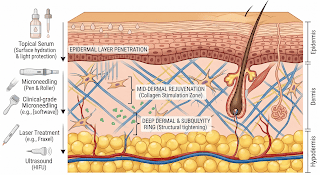
Skin is divided into distinct layers, and where you see results depends on which one is being treated:
The Epidermis: This is the topmost, visible layer of the skin. It regulates surface hydration and cell turnover.
The Dermis: Located directly underneath the epidermis, this deep layer contains the true machinery of structural aging, including fibroblasts, elastin, and the dense scaffolding of collagen fibers.
When skin sags or loses its snap, the breakdown is happening deep within the dermis. Science shows that molecules weighing more than 500 Daltons, a standard unit of molecular weight, generally cannot penetrate past the surface barrier.
Popular anti-aging ingredients like large-molecule hyaluronic acid, topical collagen, and standard peptides are simply too large to bypass this protective wall. They sit comfortably on top of the epidermis, acting as excellent moisturisers, but they cannot physically rebuild the deeper foundations.
Understanding Your Skin Architecture
Here is how the skin is layered, from the surface down:
- Topical product zone: Where creams and serums sit. Never part of the skin itself.
- Epidermis: The visible top layer. Handles hydration and cell turnover.
- 500 Dalton barrier: The cutoff point. Most skincare molecules cannot cross it.
- Dermis: Home to collagen, elastin, and fibroblasts. Where structural aging actually happens.
- Hypodermis: The fat layer beneath. Shapes facial contour and volume.
Anything applied topically must cross a significant biological boundary just to reach the dermis, let alone the hypodermis beneath it.
The Smart Consumer Skincare Audit
As a busy parent, your time and personal care budget are precious. Run a quick skincare audit to divide your vanity table into two clear categories based on what science proves they can do.
1. Surface Protection & Texture (The Epidermis Layer)
This is where over-the-counter products excel. High-quality daily sunscreen blocks UV rays from destroying existing collagen. Retinoids are proven to speed up surface cell turnover to fade dark spots, while lightweight humectants like glycerin pull moisture into the topmost cells to temporarily plump out fine lines caused by dryness. Keep this part of your routine simple, functional, and budget-friendly.
2. Deep Structural Support (The Dermis Layer)
If your primary concern is actual sagging, loss of elasticity, or a softening jawline, cream formulations will not suffice. To address the deeper structural layers where collagen loss lives, you must look beyond the vanity mirror.
Beyond Creams: Non-Surgical Clinical Care
British consumers are becoming increasingly savvy to the limitations of traditional cosmetics. The UK aesthetics market is now worth more than three billion pounds, and a UK clinic trend data shows that ultrasound and other energy-based treatments are among its fastest-growing categories, as more people choose technology over traditional surgery.
Rather than spending more on creams, many are turning to energy-based clinic treatments that bypass the 500-Dalton barrier completely.
These advanced procedures use targeted heat or ultrasound waves to pass straight through the epidermis. By delivering energy into the deep dermal tissue, they prompt the body to kickstart its own collagen production.
Serums and moisturisers can only ever work on the surface, so anyone dealing with real sagging or volume loss needs a different kind of help. Choosing a non-surgical sofwave treatment uses focused ultrasound to heat the mid-dermal layer and trigger fresh collagen production from within. It is the kind of targeted, deep-acting support that no amount of cream can replicate, filling the gap that regular surface formulations simply cannot reach.
Making Your Investment Count
True skin longevity is about working with your biology rather than fighting it. There is absolutely a place for luxury texture creams if they bring you joy and comfort during a busy self-care routine. Treat the surface of your skin with protective, budget-conscious daily staples, and leave the heavy lifting to advanced clinical technologies designed to work where aging actually happens.